
Recently ITU-D Study Group 1 organised in Geneva a workshop on “Next-generation broadcasting: challenges and prospects for developing countries”.
The workshop brought together experts from different continents and backgrounds to discuss the evolution of broadcasting, emerging technologies, spectrum management, regulatory and policy challenges, and countries’ experiences in the transition to digital broadcasting.
Some of the key topics included: application-oriented television, digital radio and IP-based delivery are reshaping the broadcasting landscape, and what this means for developing countries working towards a sustainable transition.
An important theme was also the role of broadcasting in emergency communication and early warning systems, particularly in an era of disinformation and AI-generated content.
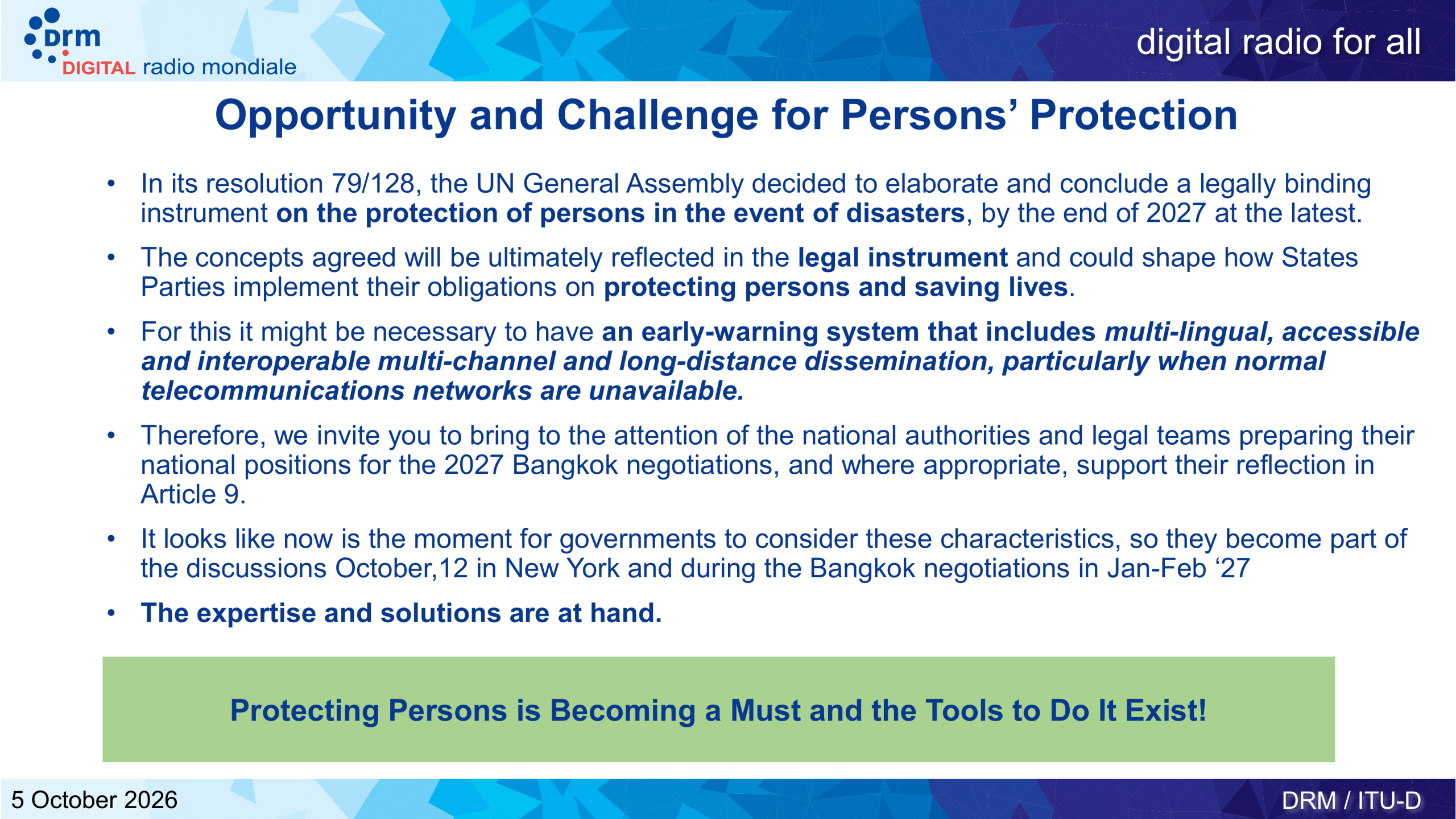
In her presentation the DRM chairman, Ruxandra Obreja, focused on the technical platform that can be used in case of disasters. She explained that digital radio is not just for information and entertainment but also for emergency warnings. DRM can protect persons in the face of disasters as the emergency warning functionality (EWF) is an integral and tested part of the DRM standard. She urged the wider UN community to include digital radio in any legal UN document aimed at protecting people’s lives. For this it might be necessary to have an early-warning system that includes multi-lingual, accessible and interoperable multi-channel and long-distance dissemination, particularly when normal telecommunications networks are unavailable. As it was stressed during the presentation, the tools, expertise, and implementation path exist. States and authorities need to fully engage with this now.

See also: DRM provides the complete solution for emergency alerts for more on DRM’s role in emergency warnings.
