The DRM Consortium features prominently in the October 2026 edition of AROI’s Radio Industry Insights, with a five-page advertorial. The Association of Radio Operators for India (AROI) serves as the official organization representing private commercial radio stations across India.
The DRM advertorial sets out how India’s private broadcasters can build a stronger radio business by adding digital services on top of what the country already has — the spectrum direction, the transmission infrastructure, the audiences and a growing DRM receiver base. The choice of standard, it argues, is a long-term industrial decision, not simply technology procurement.
In the same newsletter, AROI Secretary General Uday Chawla calls for FM receivers to be re-enabled on India’s smartphones. The DRM advertorial adds a reason: where a compatible FM front-end is already fitted, DRM-FM reception can be implemented largely in software rather than in new silicon — and xHE-AAC, the codec DRM uses, already ships in the major mobile operating systems.
The full DRM advertorial follows below:
Digital Radio DRM, Built on What India Already Owns
India already has the spectrum direction, the transmission infrastructure, the audiences and a growing DRM receiver base. The opportunity now is to turn those assets into a stronger digital-radio business.
India's private radio industry has focused on value, not audience — and digital radio belongs in that argument not outside as an engineering upgrade or an international trend to join. A standard chosen now stays in the national infrastructure for decades, reaching past spectrum and transmitters into automobiles, semiconductors, emergency communications and manufacturing. This is a long-term industrial decision, not simply technology procurement.
The decision has already moved
In October 2025, TRAI issued its recommendations on a digital radio broadcast policy for private broadcasters. This industry's attention has gone, rightly, to the commercial terms — reserve prices, authorisation periods, revenue-share fees, the migration window — and to the questions of renewal, parity and taxation being pressed across ministries.
But the same recommendations significantly narrow the technical direction. TRAI recommends a single national digital-radio technology in VHF Band II — 88 to 108 MHz, the existing FM band — with an initial rollout framework for thirteen A/A+ cities. The recommended simulcast model provides one analogue, three digital and one data channel on the assigned spot frequency.
The choice of technology remains with the Government. That means the spectrum direction, initial markets, and service model are already clearly defined in the TRAI's recommendation. The standard is now one of the central remaining decisions — and one with significant implications for migration cost, infrastructure and receiver readiness.
Six things India needs
A standard is judged on two things: what it can do, and what it costs to do it. India's requirements are specific — and they are a broadcaster's requirements, not of a vendor.
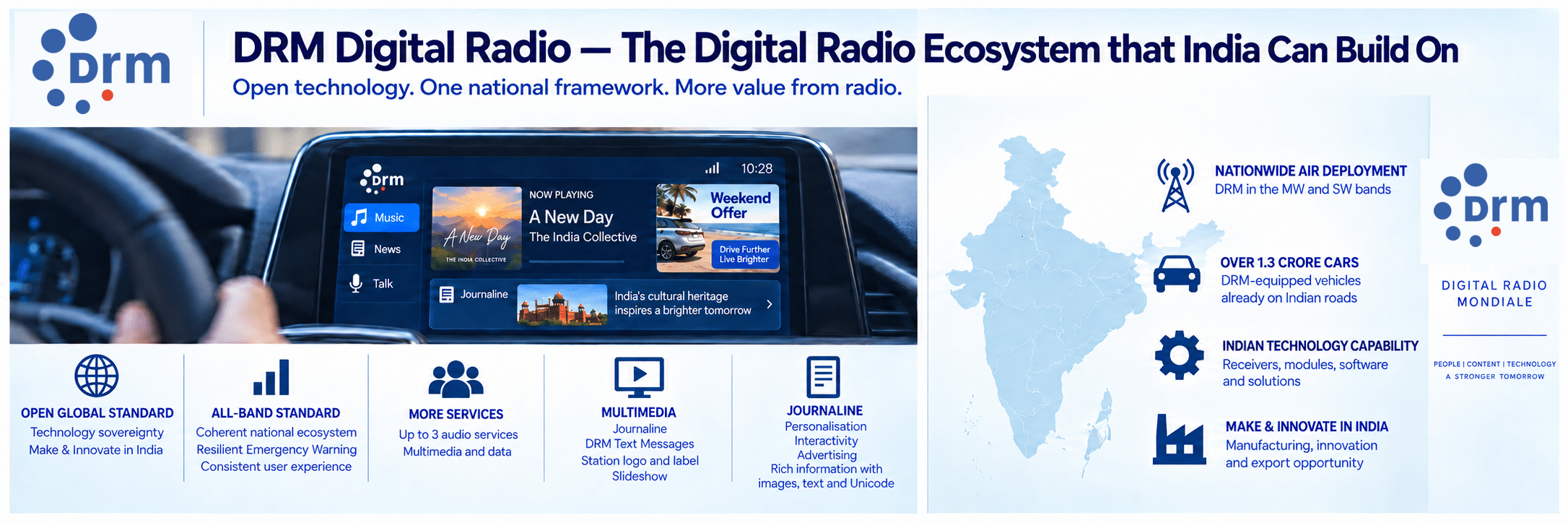
Digital Radio Mondiale (DRM) answers all six, and it is already broadcasting in India.
- Published in full, not on request: The specification and the licensing terms are both public, so a fifteen-year commitment can be examined before it is made — and so that Make in India can mean Indian companies implementing, innovating and exporting, rather than assembling someone else's technology under licence. This ensures an Indian ecosystem can grow around the standard rather than through a gatekeeper.
- Simulcast as a choice, and a bridge — not a permanent state: What the digital services carry and which frequency they use should be the broadcaster's decisions: mirror the existing output, put something new on air, or do both. One transmission should be able to serve more than one station. And going fully digital later should stay open, rather than be ruled out by the architecture.
- A cost that divides: Private FM shares towers because single-operator infrastructure was never affordable here. The digital layer should be shareable on the same principle, not funded chain by chain.
- A coherent national radio ecosystem: India already operates digital radio in the AM bands. A technology that can extend the same service framework, receiver expertise and emergency-warning capabilities into FM can reduce ecosystem fragmentation
- An ecosystem already here: Receivers already in Indian cars and Indian homes, and Indian companies are already building them — capability in production, not in prospect.
- More business from the same frequency: The three digital services and the data channel TRAI's own model assumes, carried within the assignment a station already holds — a licence that starts carrying more than one thing.
Sovereignty is not isolation. It is a choice.
The first of those requirements is usually described as technology sovereignty. For infrastructure expected to remain in service for decades, technology sovereignty is best understood as a long-term choice. It does not mean turning away from international technology. It means choosing an internationally standardised open system that Indian companies can understand, adapt, implement, compete around and export.
DRM is standardised through ETSI and endorsed in ITU-R recommendations, with the associated intellectual property commitments declared on FRAND terms, and no manufacturer needs a bespoke licence or a confidentiality agreement to gain access to it. For a broadcaster signing up for a fifteen-year authorization that is a procurement fact before it is a principle: equipment can be tendered competitively, the upgrade path does not belong to one supplier's roadmap, and what is bought in year one needs nobody's permission or additional payment terms to remain serviceable in year ten.
Openness alone does not separate India's options, since more than one system is openly standardised. India is among the world's leading centres of DRM receiver implementation, from chipset design to software-defined radio. Inntot, in Kerala, supplies a DRM receiver stack already used in more than 25 lakh cars. NXP's Indian operations are a global hub for its DRM development. That capability grew because the DRM specification was open to build against. What Indian companies build on it, they can also export — and the value stays here.
Protect the audience first, full transition to digital later
The most valuable asset remains the audience, so FM must stay available while listeners move gradually towards digital. DRM's True Simulcasting, built on its Alternative Frequency Signalling, lets a receiver associate the digital and analogue versions of a service and select the better one automatically, and point to a related station when a listener travels between coverage areas. Most of that happens invisibly. What changes for the broadcaster is the nature of migration: rather than asking an audience to choose between the old service and the new, FM protects existing reach while digital proves its value.
Two things follow:
- The digital signal does not have to sit on the analogue station's own frequency: the link is made by signalling, not by adjacency, so the block can be placed wherever the frequency plan allows. And every service in a DRM transmission carries its own alternative-frequency information, not merely the first, so a single DRM block can simulcast several stations at once.
- The digital services do not have to be the same as the analogue. The broadcaster chooses, service by service — mirror the flagship so its audience follows across without noticing, mirror a second station from the same shared transmission, or use the capacity for programming that has never been on air. TRAI's own configuration assumes as much: one analogue channel and three digital ones was never a specification for copies.
Simulcast is a stage, not the destination. As receivers spread, services can move to digital-only and release the spectrum and transmitter power analogue was consuming. DRM is fully digital, not permanently hybrid — so when to retire analogue stays the broadcaster's commercial judgement. That is a transition, not a permanent obligation.
Add digital capacity without rebuilding FM
India has invested substantially in FM sites, towers, combiners and antennas. How much of that keeps serving broadcasters while a digital layer develops alongside it depends on which of two routes is taken.
Digital can be added alongside analogue from the existing transmitter: in 300 kHz — the analogue carrier plus one 100 kHz digital block — one analogue service, three digital audio services and a Journaline text service, with the tuning frequency unchanged. Transmitter, combiner and antenna may need upgrading, and at a shared site that means real exposure: hours off air while equipment is changed, coverage lost where an antenna or feeder is re-engineered, a combiner retuned or replaced at a cost carried by everyone on the tower, and the case where one operator declines and nobody else can proceed.
The second route is built for how Indian private FMs actually transmit. A separate low-power digital transmitter at the shared site broadcasts in the white space between existing FM stations, and up to eight broadcasters share it. The high-power combiner is not modified, the antenna and feeder are untouched, and the analogue chain keeps running — no downtime, and no coverage lost. Each broadcaster keeps control of its own content and multiplex, CapEx and OpEx are divided between participants, and operators who are not ready can join later.

One Nation, One Standard, Every Band
All India Radio has broadcast DRM in medium wave for years carrying two to three audio services plus Journaline text from a single transmitter; operated in full-digital mode, that network can serve in the region of 900 million people. Medium wave is how rural and border India is reached, and it is not going away because the metros go digital.
DRM is one system across medium wave, short wave and FM — the same features, the same codec, the same receiver technology. That has a consequence for public safety beyond convenience. DRM's Emergency Warning Functionality is built into the standard, CAP-integrated and geo-targeted. It works without an internet connection and does not require a broadcaster to interrupt its own programming.
Because the standard behaves consistently in every band, alerting works as one system. A listener does not have to be tuned to the right service to be reached: the warning finds the receiver, which switches to the emergency programme automatically. An alert carried across the bands is therefore a single warning with independent paths to the citizen — and that is what makes national emergency communication resilient.
India already has the ecosystem
Receiver availability is usually the hardest part of any transition. Here India has a genuine advantage. More significant for private FM: over 1.3 crore vehicles on Indian roads already carry DRM-capable infotainment systems, and DRM is a default feature at no added cost to the buyer in around a third of new cars sold in the country. Most can be upgraded to receive DRM in the FM band without hardware changes.
This also means that India has accumulated real DRM receiver knowledge, automotive integration experience and supplier capability — and that matters beyond the receiver count. Automotive systems have long development cycles, and standing up an entirely new radio competence means integration, validation, testing, supply-chain support and lifecycle maintenance. Building on capability already in the market reduces more than hardware cost. It reduces ecosystem complexity.
Mobile devices are another route to scale. Where a compatible FM front-end is already fitted, DRM-FM reception can be implemented largely in software rather than in new silicon, and xHE-AAC — the codec DRM uses — is already supported across the major mobile operating systems. At IBC in Amsterdam this September, CML Micro went further, demonstrating DRM embedded in wearables — headphones and earbuds — with the receiver sitting in the earbuds or their charging case, paired to a phone over Bluetooth. DRM's technical barrier to wider receiver availability is low. What it needs is policy clarity and market demand.
Digital should create a bigger radio business
For broadcasters, digital does not just mean better audio. It means a licence that starts carrying more than one thing.
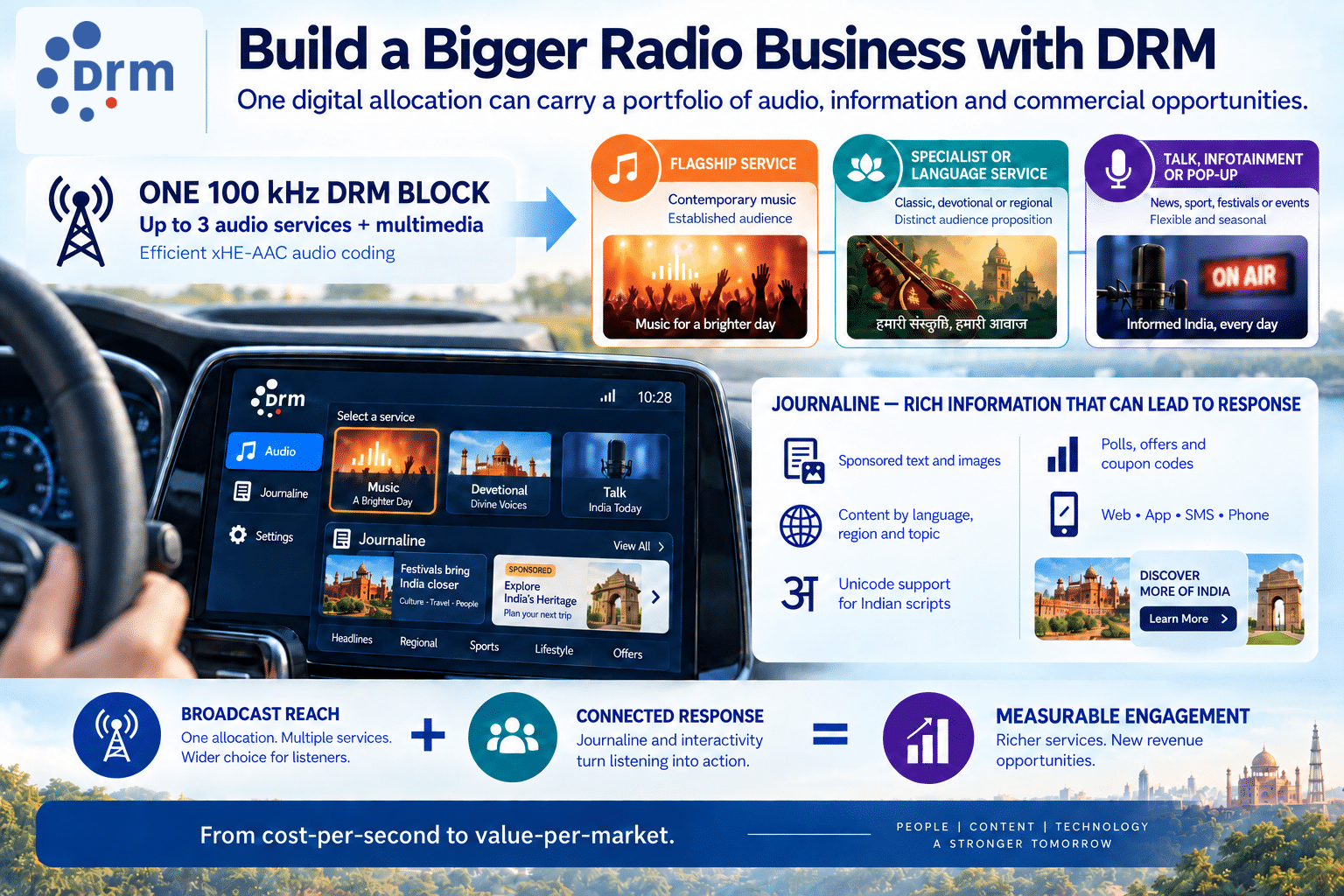
A 100 kHz DRM block carries up to three audio services using the xHE-AAC codec, alongside digital information and multimedia. That is a portfolio from one frequency: a contemporary music service, a classic or devotional service reaching an older audience, and a talk and infotainment brand — three differentiated audience propositions from one digital allocation. Or a second language stream where the Ministry's 20% local-language requirement is an opportunity rather than an obligation. Or a pop-up station for a festival or a cricket season. All textual elements are Unicode-based, so every Indian script is supported natively.
Journaline is the part that should hold a sales director's attention. It carries sponsored text and graphics sorted by language, region and topic, and supports interactivity — polls, phone participation, coupon codes, links — leading a listener into a mobile, web or telephone return path where connectivity exists. Broadcast provides the scalable one-to-many delivery layer; where the listener follows a connected return path — web, app, phone, SMS or coupon — that interaction can become measurable. An industry moving from cost-per-second to value-per-market has been asking for precisely that combination.
The right question, and the next step
International deployment experience matters, and it should. Digital Radio Mondiale has it: Indonesia and South Africa adopted the standard nationally in 2025, it is the prevailing standard in China and Nepal, and All India Radio has been broadcasting it for years. Those are also priority markets for Indian automotive and electronics exports.
But India's conditions are its own: its FM spectrum environment, its shared-infrastructure architecture, one of the world's largest automotive markets, extraordinary linguistic diversity, and an increasingly ambitious electronics and software industry.
So, the question is not which digital radio technology has been deployed most elsewhere. It is which one builds the strongest future from the infrastructure, spectrum, audiences and industrial capability India already has. Against those criteria, DRM presents an unusually relevant case for India's next phase of radio digitisation: a platform already operating in India, supported by an existing receiver and technology ecosystem, and designed for a flexible transition in the FM band.
DRM-FM pilot involving private broadcasters, AROI, government, transmission organisations, automotive manufacturers and Indian technology companies and other stakeholders could establish what actually matters: coverage and reception, analogue-to-digital continuity, impact on shared transmitter infrastructure, CapEx and OpEx per broadcaster, automotive performance, and the depth of domestic supplier participation and, — no less important, the business case: what the additional services and the data channel can be sold against, and how digital listening is measured, which is what turns added capacity into revenue rather than cost.
India's radio transition to digital should protect what works today, create new value for broadcasters tomorrow, and leave the country able to innovate around and shape a platform it will depend on for decades. India does not merely need a digital radio standard. It needs a digital radio ecosystem it can build on.
This article appeared in the October 2026 edition of AROI’s Radio Industry Insights.
